
Rapid Chloride Penetration Test (RCPT)
Confidential RMC | Concrete Durability Assessment
Client: Confidential RMC
Service Provider: Falcon Industrial Testing Laboratory Pvt. Ltd., Chennai
Category: Building Materials Testing | Concrete Durability Assessment
Project Duration: Oct 2026
Test: Rapid Chloride Penetration Test (RCPT)
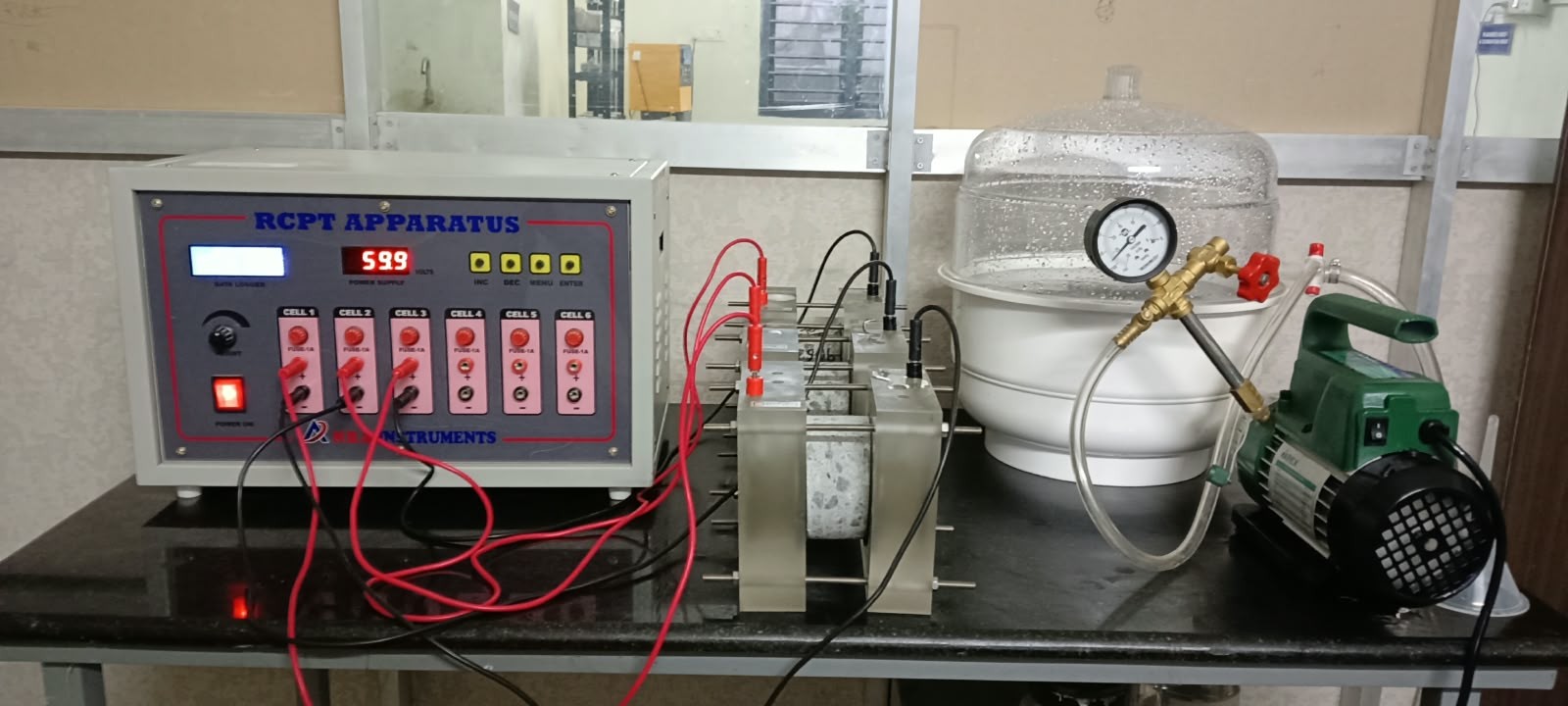
Figure 1: RCPT apparatus and specimen cell arrangement at Falcon Industrial Testing Laboratory Pvt. Ltd.
1. Introduction
The durability of concrete is a critical factor in ensuring the long-term performance, structural integrity and service life of buildings and infrastructure. In reinforced concrete structures, the ingress of chloride ions can contribute to corrosion of embedded steel reinforcement, potentially resulting in cracking, spalling and premature deterioration.
Falcon Industrial Testing Laboratory Pvt. Ltd. carried out Rapid Chloride Penetration Test (RCPT) testing for a Ready-Mix Concrete (RMC) client whose identity is kept confidential. The testing was undertaken to evaluate the electrical indication of the concrete's resistance to chloride ion penetration and support concrete durability assessment.
2. Objective of RCPT Testing
The primary objective of the Rapid Chloride Penetration Test is to obtain an indication of the concrete's resistance to chloride ion penetration through measurement of the electrical charge passing through a prepared concrete specimen under controlled test conditions.
- Evaluation of concrete durability characteristics.
- Assessment of resistance to chloride ingress.
- Quality control and comparison of concrete mix designs.
- Evaluation of concrete incorporating supplementary cementitious materials.
- Technical assessment for structures exposed to potentially aggressive environments.
3. Testing Standard
The test is performed with reference to the applicable requirements of:
- ASTM C1202 – Standard Test Method for Electrical Indication of Concrete's Ability to Resist Chloride Ion Penetration.
- IS 516 (Part 5/Sec 1):2018 – Applicable Indian Standard method for determination of chloride ion penetration resistance, where specified by the project.
The applicable standard and its edition are confirmed according to the project specification and agreed testing requirements.
4. RCPT Testing Methodology
Stage 1 – Specimen Preparation
Concrete specimens are prepared to the dimensions and condition required by the applicable test method. Specimen identification, age and relevant curing details are documented.
Stage 2 – Conditioning & Cell Preparation
The specimen is conditioned as prescribed by the selected standard and mounted securely in the RCPT test cell. The two faces are exposed to the respective test solutions in accordance with the procedure.
Stage 3 – Electrical Connection
Electrical connections are established across the test cell using the RCPT apparatus. The arrangement is checked to ensure suitable contact, sealing and stable operation.
Stage 4 – Application of Electrical Potential
A controlled electrical potential is applied across the concrete specimen. For ASTM C1202, the test is normally conducted at 60 V for six hours, with current readings recorded at the specified intervals.
Stage 5 – Data Recording & Calculation
The current passing through the specimen is monitored throughout the test. The total electrical charge passed is calculated and expressed in coulombs in accordance with the applicable standard.
Stage 6 – Reporting
The observations and calculated results are reviewed and documented. The report identifies the specimen and test method and presents the results for interpretation against the applicable acceptance criteria, where specified.
5. RCPT Test Apparatus at Falcon Lab
Falcon Lab's RCPT testing facility is equipped with a multi-cell test arrangement, electrical control unit, specimen holders, connecting leads and a vacuum-assisted conditioning arrangement.
The setup supports controlled testing of prepared concrete specimens under the prescribed electrical conditions.
6. Understanding RCPT Results
The total electrical charge passed provides an electrical indication of the concrete's resistance to chloride ion penetration. Under ASTM C1202, the conventional qualitative interpretation is:
| Charge passed (coulombs) | Chloride ion penetrability indication |
|---|---|
| Greater than 4,000 | High |
| 2,000–4,000 | Moderate |
| 1,000–2,000 | Low |
| 100–1,000 | Very low |
| Less than 100 | Negligible |
These categories are indicative classifications under the ASTM method and should not automatically be treated as project acceptance limits.
RCPT results can be influenced by concrete composition, pore-solution chemistry, specimen age and curing conditions. Consequently, the results should be interpreted alongside the mix design, exposure conditions, project requirements and other relevant durability assessments.
7. Importance of RCPT Testing for RMC Producers
For Ready-Mix Concrete producers, durability testing provides useful technical information for evaluating concrete performance beyond compressive strength alone.
- Compare the durability characteristics of different concrete mixes.
- Support mix-design development and performance evaluation.
- Assess the effects of supplementary cementitious materials.
- Maintain documented quality-control records.
- Provide technical information for projects requiring enhanced durability.
The test is particularly relevant when evaluating concrete intended for reinforced concrete structures exposed to chloride-bearing environments, subject to the limitations of the test method.
8. Falcon Lab's Commitment to Quality Testing
Falcon Industrial Testing Laboratory Pvt. Ltd., Chennai, provides testing services for building materials, concrete, soil, water, wastewater, environmental samples and other construction-related materials within its applicable testing scope.
The laboratory's approach focuses on appropriate test methods, controlled testing conditions, traceable observations and clear technical reporting to support clients in construction quality assurance and material performance assessment.
The RCPT testing undertaken for Confidential RMC reflects Falcon Lab's support for concrete durability evaluation and the quality requirements of the ready-mix concrete industry.
9. Conclusion
Rapid Chloride Penetration Testing is a useful tool for evaluating the electrical indication of concrete's resistance to chloride ion penetration. When conducted and interpreted appropriately, it provides valuable information for concrete durability assessment, quality control and mix-design evaluation.
Falcon Industrial Testing Laboratory Pvt. Ltd. remains committed to supporting RMC producers, construction companies, infrastructure developers and consultants with reliable building-material testing services.
Need RCPT testing for your concrete mix?
Contact Falcon Industrial Testing Laboratory Pvt. Ltd., Chennai, to discuss specimen requirements, applicable test standards, sample submission and reporting.
Project Information
Confidential RMC
Falcon Industrial Testing Laboratory Pvt. Ltd., Chennai
Building Materials Testing | Concrete Durability Assessment
Infrastructure
Oct 2026
ASTM C1202
IS 516 (Part 5/Sec 1):2018
Rapid Chloride Penetration Test (RCPT)